
Comparing Mood Boards With Your Partner: What We Learned From Our Own Reports
My husband and I have lived in the same house for years, shared the same rooms, made a thousand small decisions about how to fill them. So when I built Psyche Home, I was genuinely curious what would happen if we both took the assessment separately and compared what came back.
The results surprised me, not because we were so different, but because of how much we actually matched.
The Mood Boards, Side by Side
Look at our two boards next to each other and the first thing you'll notice is teal. It shows up in both, in almost the same saturation, across upholstery, drapery, and accents. If you only glanced at the palette tiles, you'd think we were nearly the same person.
Even our official palettes prove it. Sixty percent off-white, thirty percent teal, in almost identical shades, for both of us. The only real difference is the accent: dusty pink for me, bright blue for him.
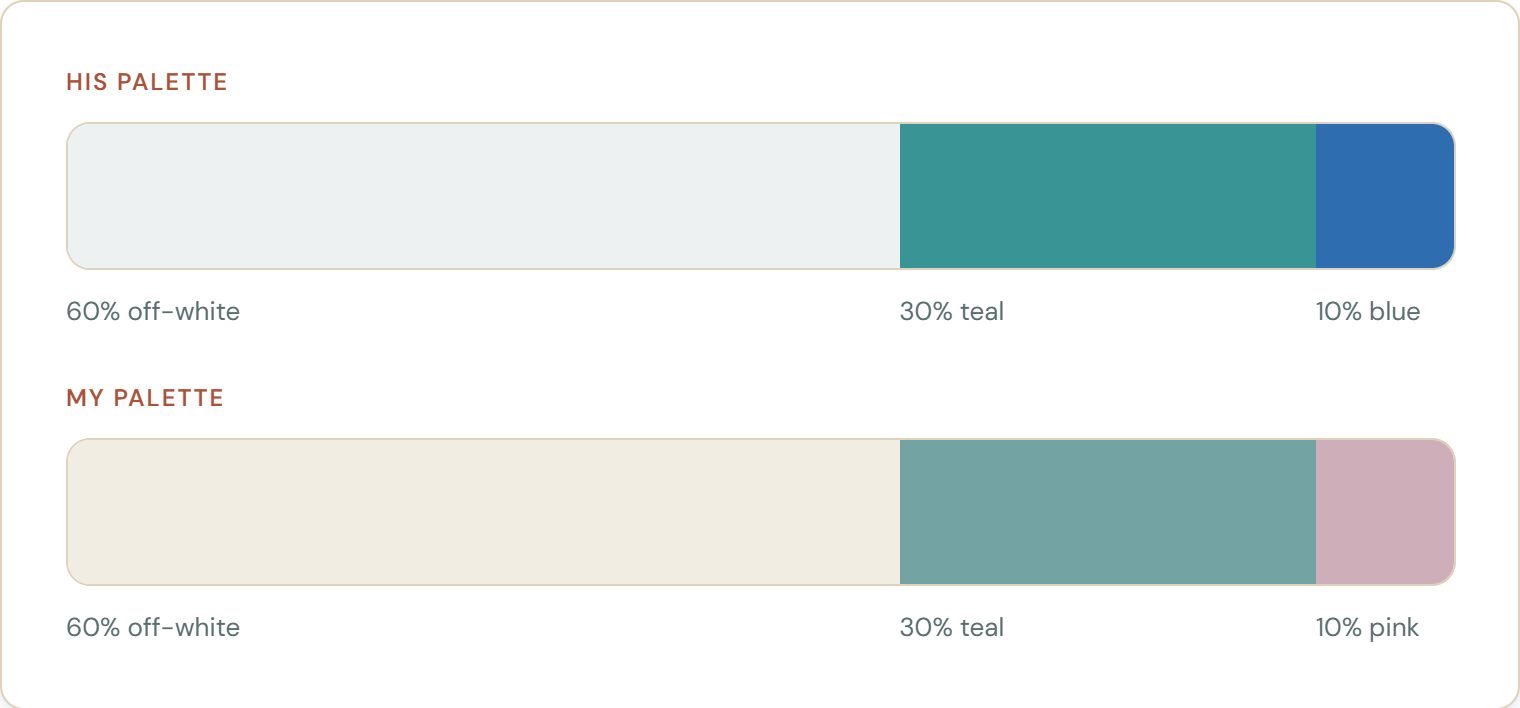
Sixty percent off-white, thirty percent teal, for both of us. The only real difference is the last ten percent.
His mood board:
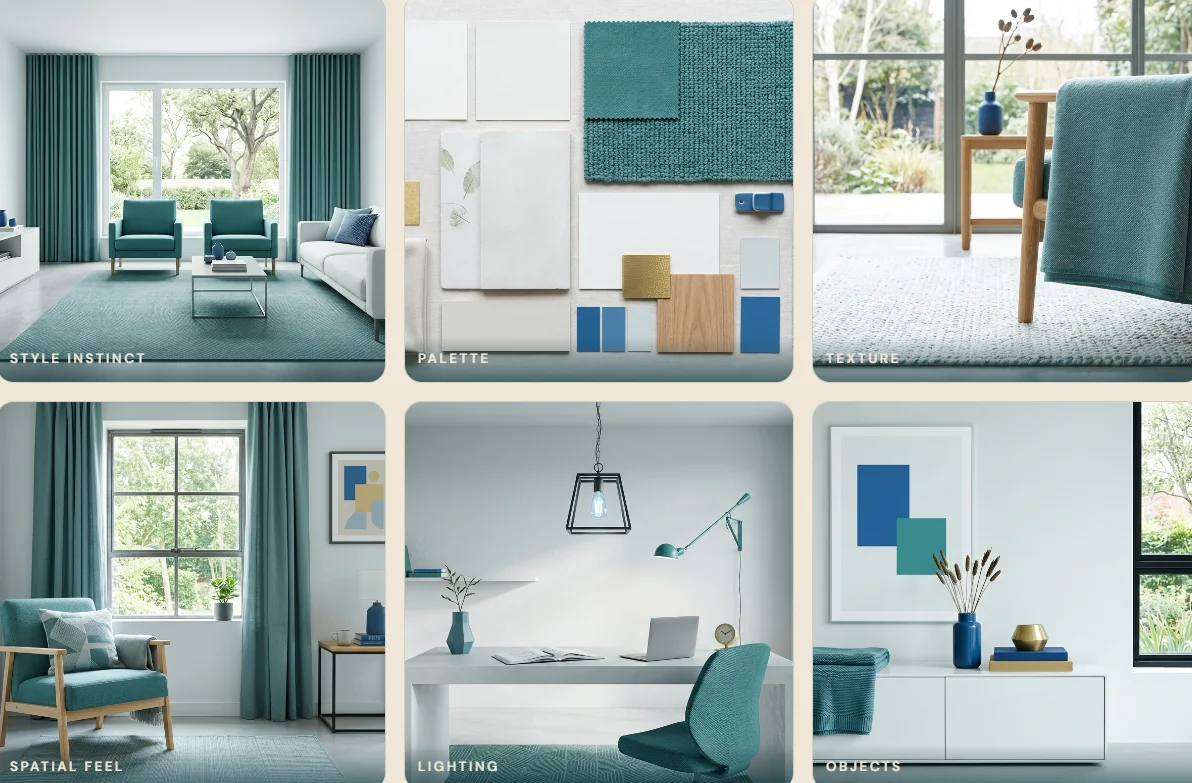
His board: teal, clean lines, restraint.
My mood board:
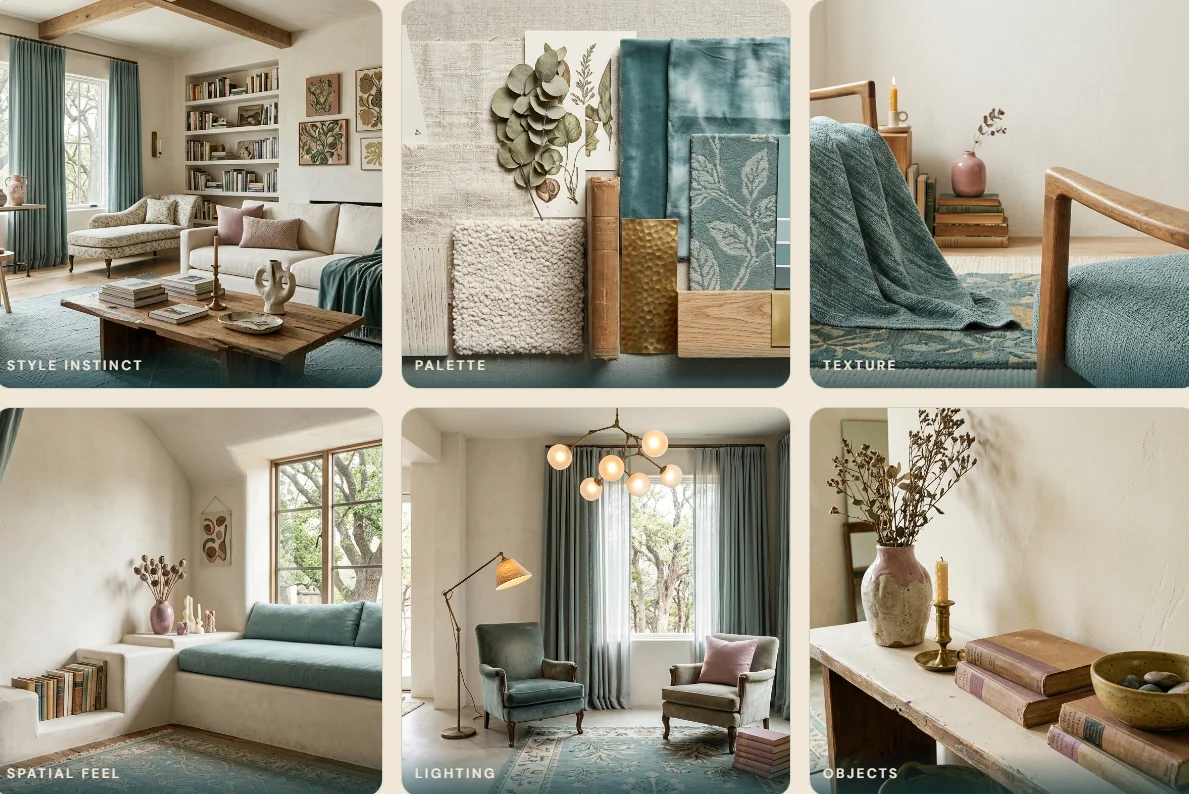
Mine: a similar teal, layered with pattern, texture, and age.
Keep looking, and the story changes.
My Style Instinct and Spatial Feel boards lean collected and eclectic, a built-in daybed nook, a gallery wall, exposed wood beams, a room that feels gathered over time rather than furnished all at once. His is clean-lined and modern, a crisp white sofa, a glass coffee table, symmetrical and uncluttered.
The Texture boards tell the same story from a different angle. Mine calls for tasseled fringe, aged book spines, plaster walls, fabric with real weight and a little history to it. His is nubby and contemporary, simple and consistent.
Lighting might be the sharpest contrast of all. My fixture is organic and sculptural, a branching chandelier with soft glass globes that reads almost like candlelight. His is geometric and architectural, a wire-framed pendant paired with a sleek task lamp.
And in Objects, mine gathers dried branches, a patinated vase, stacked antique books, brass candlesticks, small things that suggest a story. His stays restrained, geometric art, clean lines, no clutter, no narrative required.
What the Personality Data Actually Showed
Here's what I didn't expect. When I pulled our Big Five results side by side, we matched almost exactly on four out of five traits.
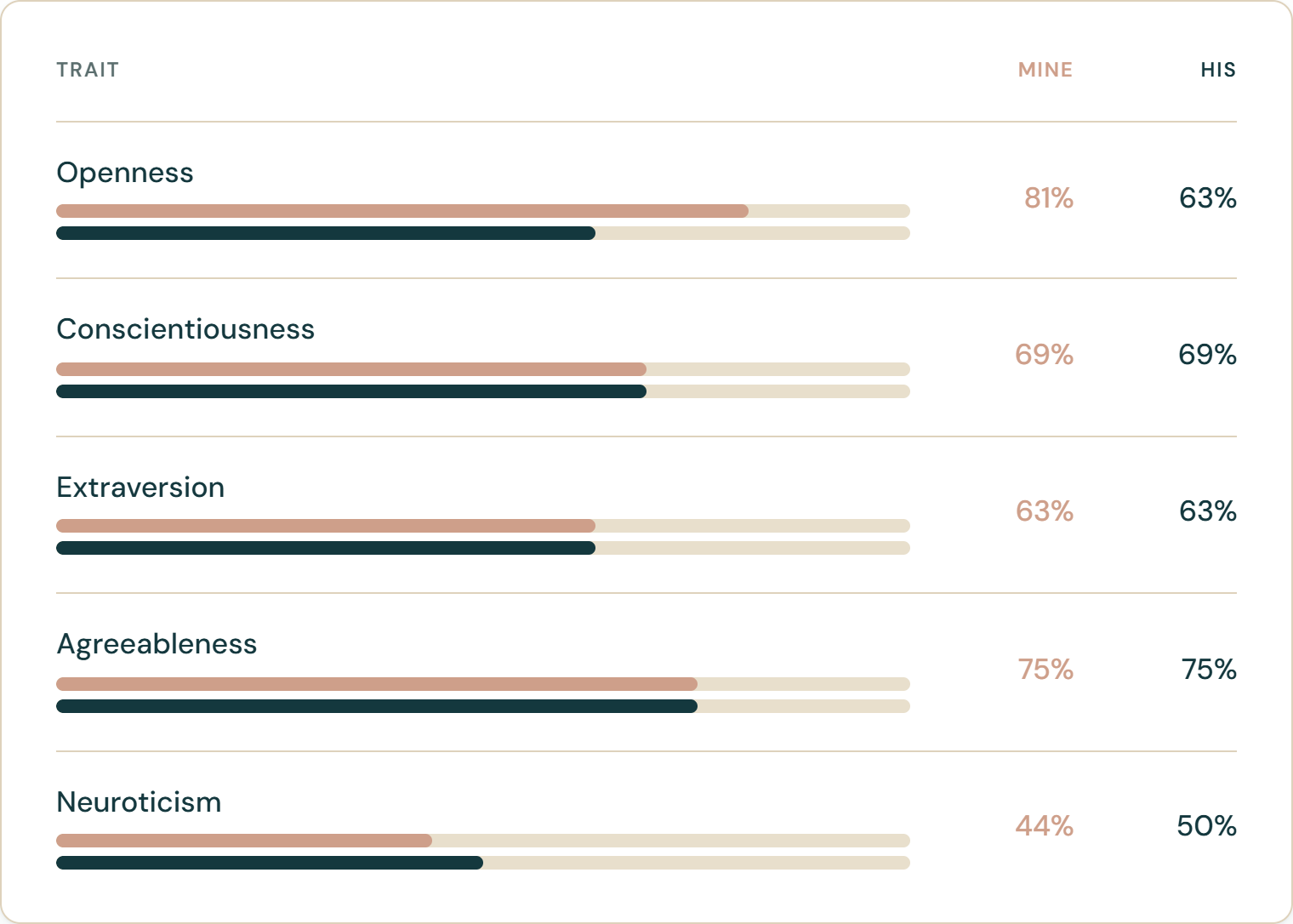
Four traits nearly identical. Openness is the outlier — eighteen points, and the source of every difference above.
Conscientiousness: Both High, both 69%. Extraversion: Both Average, both 63%. Agreeableness: Both High, both 75%. Neuroticism: Both Average, 44% and 50%, close enough to round together.
We are, it turns out, remarkably alike in how organized we want our home to be, how much company we need versus how much quiet, and how much warmth we bring into a shared space. Neither of us is the tidy one and the messy one. Neither of us is the introvert and the extrovert. On paper, we run the same.
The one real gap is Openness. Mine came in at 81%, High. His came in at 63%, Average. Eighteen points, and it turns out that single number is doing almost all the work behind everything you see in the mood boards.
My higher Openness is what pushes my Style Instinct toward eclectic and unconventional, even though we both technically landed on "transitional" as a starting word. It's what calls for botanical pattern and an "irregular, complex, novel" spatial feel in my report, and what calls for geometric pattern and a "structured, orderly, symmetrical" feel in his. It's what fills my Objects board with unexpected, gathered things, and keeps his predictable and clean.
Everything that looks like a difference in taste is really one trait, expressed twice.
What This Means If You're Merging Two Styles
Don't negotiate the bones of the room. You probably already agree on them. If your Conscientiousness and Agreeableness scores are close, and for most couples they're closer than you'd think, you likely want the same layout logic, the same balance of open and closed space, the same instinct toward comfort and durability. That's not a place to compromise. That's a place to just build.
Let color be the shared foundation, not the negotiation. Teal was never in question for us. If you and your partner already agree on a palette, let it carry real weight in the final room instead of diluting it to find middle ground that neither of you actually wants.
Let Openness lead the layering, not the structure. If one of you scores meaningfully higher on Openness, that person's instinct is the one that should govern texture, pattern, and the small personal objects in a room, the eclectic mix, the botanical print, the gathered keepsakes. The other partner's instinct is often better suited to the room's actual bones, the furniture silhouette, the symmetry, the clean lines everything else hangs on.
Split by category, not by room. Rather than negotiating every decision together, decide who leads on what. Structure and furniture shape can go to whoever's Openness runs lower. Texture, pattern, and personal objects can go to whoever's runs higher. Lighting is a good one to choose together on purpose, since it's often where the contrast shows up most, pick a fixture with clean lines but a warm, diffused bulb, something that honors both instincts instead of picking a side.
Treat your high-conviction pieces as anchors, not arguments. If one of you has a piece you already love (mine is the daybed nook, his is the glass coffee table), build the room around those instead of debating them down to something smaller.
We didn't need to find a compromise home. We needed to notice that we already agreed on almost everything that mattered, and that the one place we genuinely differed had a name, a number, and a very specific job to do in the room.
Curious what your own report says about your instincts, and what your partner's says about theirs? Take the free assessment at app.psychehome.com.